01 / NATIVE FOUNDATION
Financial state has a native owner.
Broker fills commit exposure in C++ before Python callbacks or telemetry. Exact execution identities make repeated evidence idempotent.
System design / interactive atlas
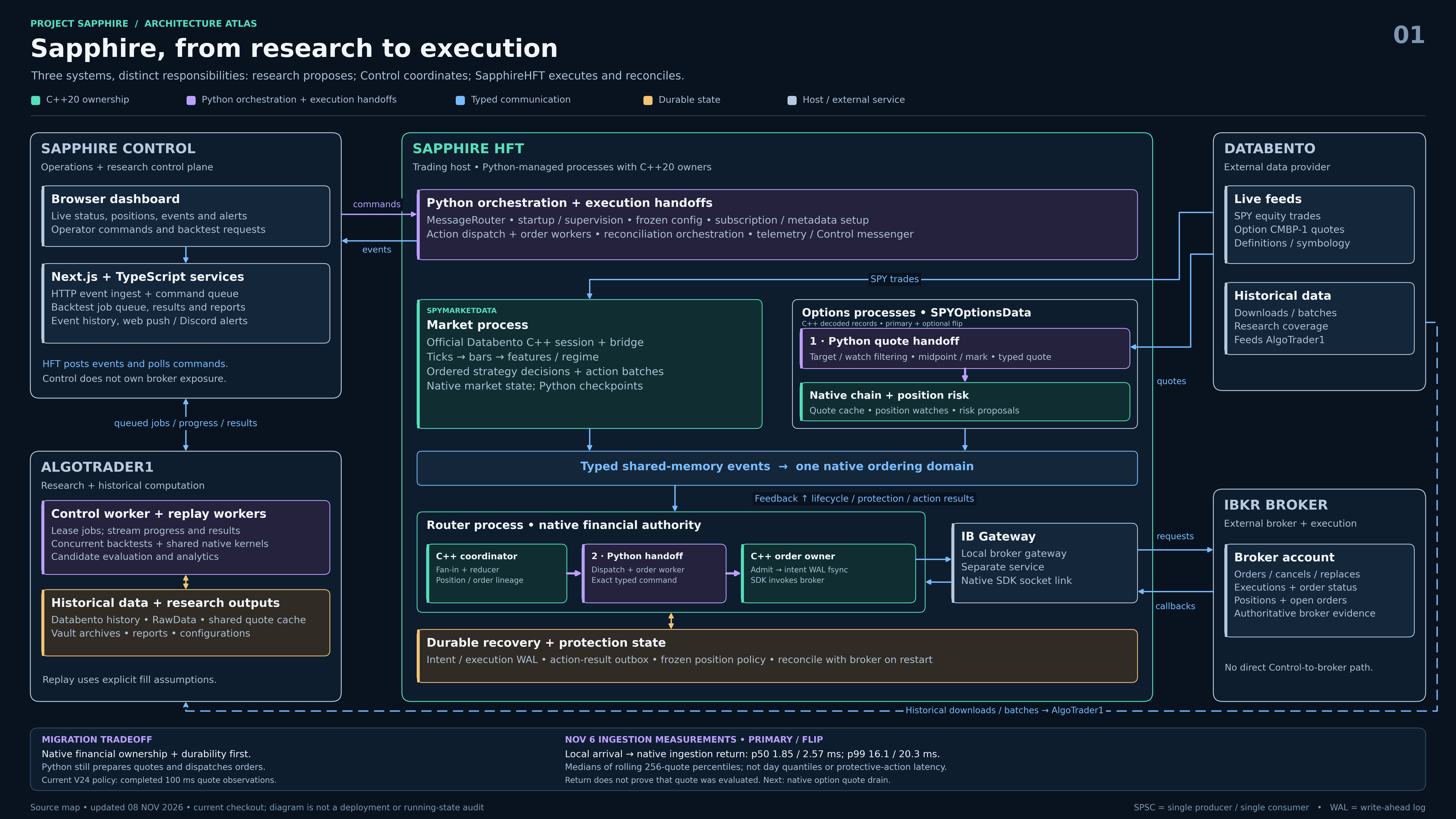
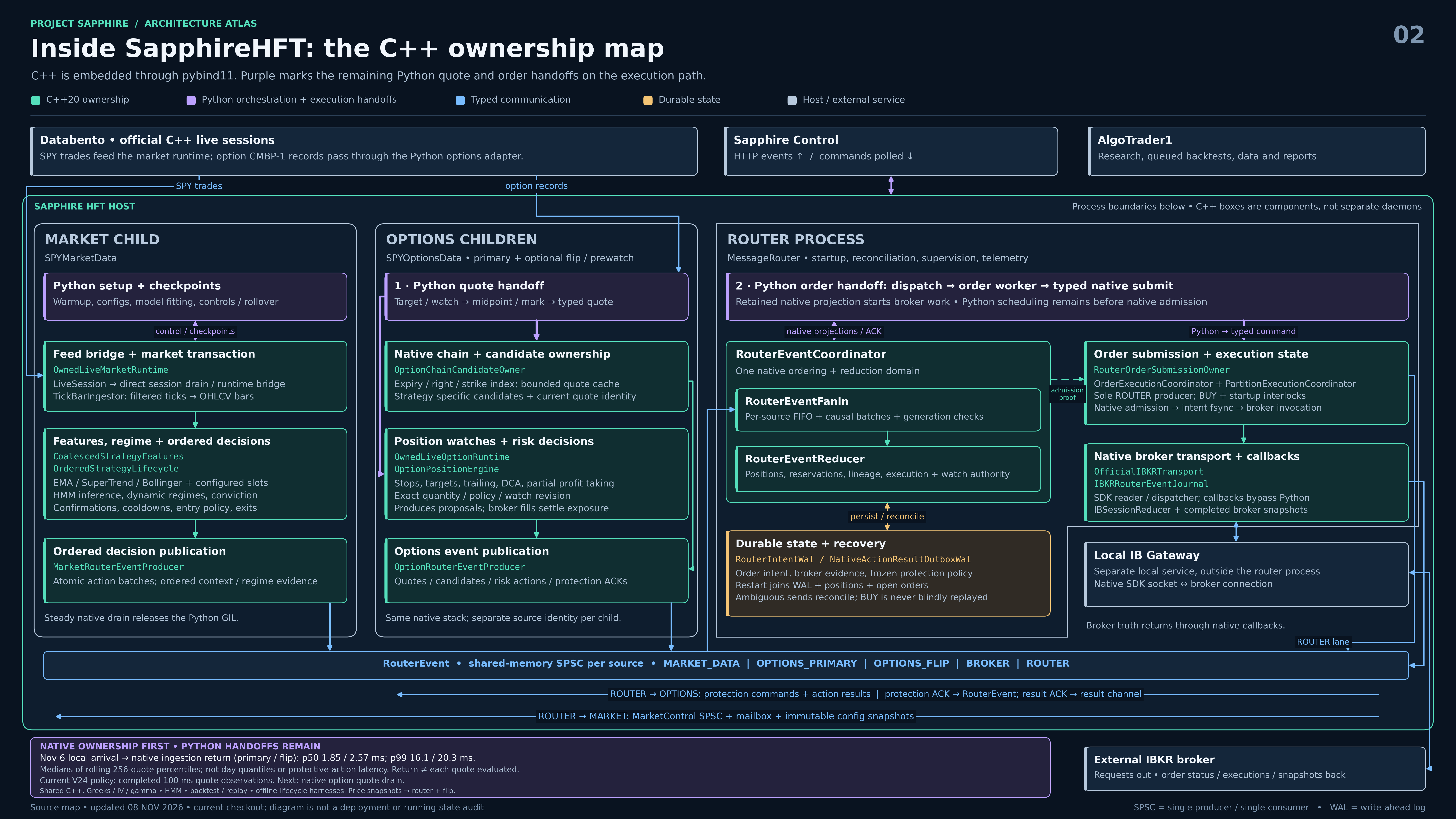
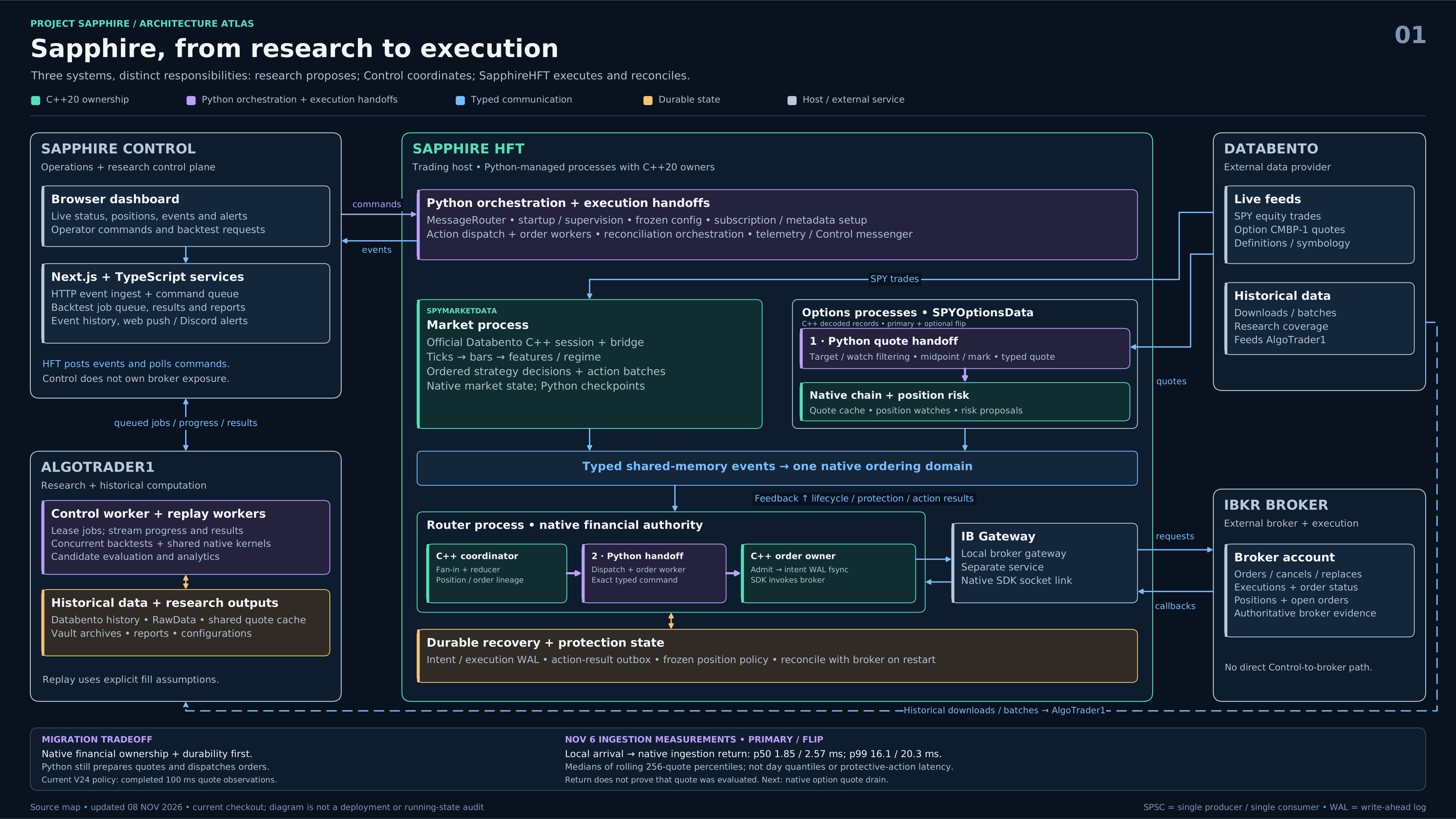
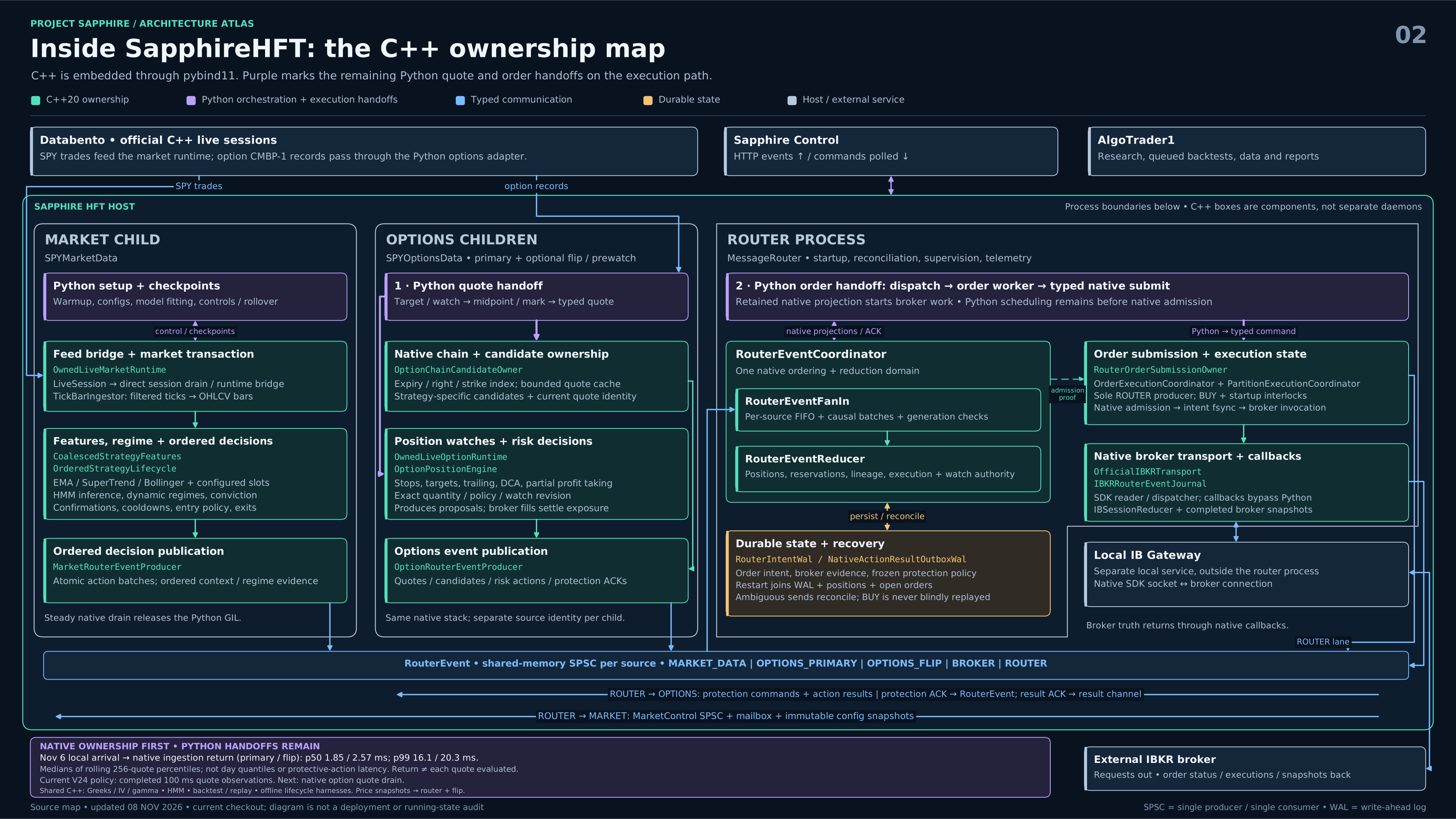
From a market observation to a protected broker position. Explore native financial ownership, trace the remaining Python handoffs, and inspect the evidence behind the engineering decisions.
Engineering choices & measured timing ↓Explore the full architecture, then step through the lifecycle of a trade. Select any component to see its role and the boundary it protects.
Engineering decisions / evidence & next steps
The C++ migration established durable order and position ownership while retaining existing Python orchestration. The remaining handoffs are visible, measured where evidence exists, and separate from financial authority.
Broker fills commit exposure in C++ before Python callbacks or telemetry. Exact execution identities make repeated evidence idempotent.
Identity checks and entry fences precede durable intent and broker invocation. An uncertain send retains its authority for reconciliation.
Fresh broker evidence rejoins retained order lineage. Position revisions bind protective watches to the quantity they actually protect.
Why this order of work
Native financial authority, durable admission, idempotence and recovery came first. Retaining the existing orchestration kept configuration, supervision and command delivery connected while those ownership boundaries moved into C++.
For the current stage, a typical 2–3 ms quote-ingestion handoff is an accepted tradeoff. The observed tail remains an optimization target. That choice is specific to this system and its current strategy.
The official C++ session receives and decodes records. Python still drains the record pump and prepares typed quote inputs before calling the native option owner. Native quote and watch state does not make this entire ingestion path native.
Measured ingestion boundary below
Python dispatch and order workers still participate before the native submission owner admits a command. Native admission, broker invocation and financial evidence retain their own authority. This separate handoff has not been benchmarked here.
Observed option-quote ingestion
Local arrival inside native translation → native ingestion return. Values below summarize rolling windows; they are not whole-session quote percentiles.
09:30–16:00 New York
45,986 telemetry snapshots
| Timing boundary / window statistic | Primary options23,218 snapshots | Flip options22,768 snapshots |
|---|---|---|
| Local arrival → ingestion returnMedian of rolling-window p50 values | 1.85ms | 2.57ms |
| Same interval, tail behaviorMedian of rolling-window p99 values | 16.1ms | 20.3ms |
| Runtime-call envelopeMedian of rolling-window p50 values · includes Python conversion | 0.058ms | 0.065ms |
Each value is the median across telemetry snapshots of a rolling 256-quote percentile. Windows may overlap. These are typical rolling-window statistics, not whole-session per-quote quantiles. Context-only quotes and watched-position quotes share the samples.
Local arrival is timestamped inside native record translation, not at the network interface.
The runtime-call interval includes Python request replacement and conversion, native locking and work, backpressure retries, and return. It is not an isolated C++ compute measurement.
Next / quote path
Move the record-drain and quote-conversion boundary into a native batch path. Preserve source ordering, sequence watermarks, exact protective-watch identity and backpressure behavior. Measure the same ingestion boundary again, with separate instrumentation for risk and action completion.
Later / order path
Moving selected actions directly to native admission is a different change. It must preserve exact command identity, the sole submission owner, durable admission and recovery semantics. The quote-ingestion measurements do not quantify this handoff or its potential improvement.